
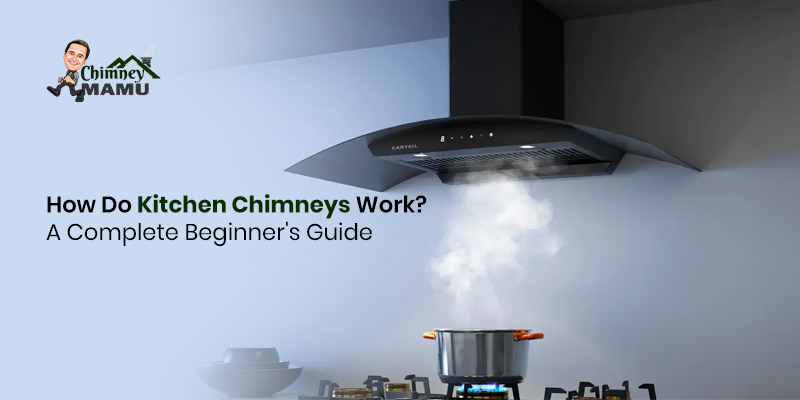

You fire up the stove, and within minutes, the whole kitchen smells like the food, which is great for dinner, but not so great for your curtains, cabinets, and lungs. That smell has to go somewhere, and that’s exactly the problem your kitchen chimney is supposed to solve. If you’ve ever wondered what it’s actually doing about it, this guide is for you.
Most people buy a kitchen chimney because the interior designer said so, or because the neighbour has one. Very few actually know how it works. That lack of understanding is also why so many chimneys end up underperforming or, worse, being ignored entirely. Until one day, the suction stops working, and you end up searching for a chimney service in Bhubaneswar in a mild panic.
How Does a Kitchen Chimney Actually Remove Smoke and Oil from the Air?
Think of your chimney as a vacuum cleaner placed above your stove. When you cook, smoke, steam, and grease particles float upward. That’s just physics. Hot air rises. The chimney uses this. A motor inside the unit creates suction that pulls this rising air up into the hood before it can spread across the room.
Once the air is pulled in, it travels through filters. These filters do the actual dirty work. They catch the grease, trap the fine particles, and in some cases absorb the odours too. After that, the air is either pushed outside through a duct or sent back into the kitchen, cleaner than it came in.
What Are the Main Parts Inside a Kitchen Chimney, and How Do They Work Together?
A kitchen chimney has more going on inside than most people realise. There are a few moving parts inside, and once you know what they are, everything else clicks:
- The hood or canopy is the visible outer shell that sits above your stove, collects rising air, and directs it inward. The wider it is, the more cooking area it covers.
- The motor creates the suction that pulls air in. Think of it as the engine. A stronger motor handles heavy Indian cooking better.
- The filters are where the grease gets caught. Baffle filters are the most common for Indian kitchens and trap grease by forcing air to change direction. Mesh filters work similarly but clog faster. Charcoal filters absorb odours and are mostly found in ductless models.
- In ducted models, the duct is a pipe that carries extracted air entirely outside the kitchen. This is the more effective of the two options.
- The recirculation system in ductless models filters the air and returns it to the kitchen. A practical option for apartments or kitchens without access to an exterior wall.
Each part depends on the others. A powerful motor means nothing if the filters are clogged. Clean filters are useless if the duct is blocked. Everything has to work together.
Types of Chimneys: Which One Is Sitting Above Your Stove?
Before getting into maintenance, it’s worth knowing what type of chimney you have. They work slightly differently, and that matters:
- Wall-mounted chimneys are fixed to the wall directly above the stove. The most common type is well-suited for kitchens where the cooking range sits against a wall.
- Island chimneys hang from the ceiling above a kitchen island or central cooking counter. These need to work harder since there are no walls to contain the smoke around them.
- Built-in chimneys are integrated into the kitchen cabinets. They’re compact and neat-looking, popular in modular kitchens with limited space.
- Downdraft chimneys work differently from the rest. They pull smoke downward rather than up, and they rise out of the counter only when you need them.
Is Chimney Service in Bhubaneswar Really Necessary or Can You Clean It Yourself?
Here’s where most people get stuck. Wiping the hood and rinsing a mesh filter under hot water is something you can do at home. The part people miss is the deep cleaning. Over time, grease builds up inside the duct, around the motor, and along the internal walls. That kind of buildup:
- Reduces suction power noticeably
- Creates a fire risk, since accumulated grease is flammable
- Makes the motor work harder than it needs to, shortening its life
- Causes the chimney to become noisier over time
That layer of buildup isn’t something a quick rinse removes. It needs a proper deep clean from professionals who know what they’re doing.
How Often Should You Get Your Kitchen Chimney Serviced?
It depends on how often you cook and what you cook. Here’s a rough guide:
Light cooking (less than once a day): service once a year.
Regular cooking (once or twice daily): service every six months.
Heavy cooking (multiple meals daily): service every three to four months.
What Happens If You Don’t Clean or Service Your Kitchen Chimney Regularly?
Most people find out the hard way. The suction slowly drops, so cooking starts to feel smokier than usual. Then the motor starts working harder to compensate, and the noise goes up. Then one day, the chimney stops pulling air effectively altogether.
At that stage, the motor may already be damaged from the overwork. What would have been a quick maintenance visit from a local chimney service in Bhubaneswar has become a repair job, sometimes an expensive one.
The kitchen takes a hit too. Grease that doesn’t get captured settles on your cabinets, walls, and ceiling. That sticky film is a nightmare to clean and, in extreme cases, a fire hazard near a gas stove.
Regular servicing isn’t about keeping things looking nice. It’s about the chimney actually doing its job.
Keep Your Chimney Running Well
A kitchen chimney isn’t a set-and-forget appliance. Regular attention and clean filters make a bigger difference to its performance than most people realise.
If your chimney has been making noises, losing suction, or simply hasn’t been looked at in over a year, Chimney Mamu offers professional chimney service in Bhubaneswar, covering everything from filter cleaning to motor checks and duct inspection. Contact us now to schedule your service.
Frequently Asked Questions
- Can I run my kitchen chimney while the windows are open?
Yes, but keeping windows closed while cooking helps the chimney work more efficiently by creating a contained space for the suction to do its job.
- Does the type of cooking I do affect how quickly my chimney gets dirty?
Heavy Indian cooking with a lot of frying and tempering deposits grease far faster than lighter cooking styles, which is why service frequency varies from household to household.
- How do I know if my chimney’s suction is weak?
If smoke visibly escapes around the hood rather than being drawn in, or if grease is settling on nearby surfaces despite the chimney running, the suction has likely dropped, and it’s time for service.